
Are you teaching your pre-teens about money?
04/03/2025
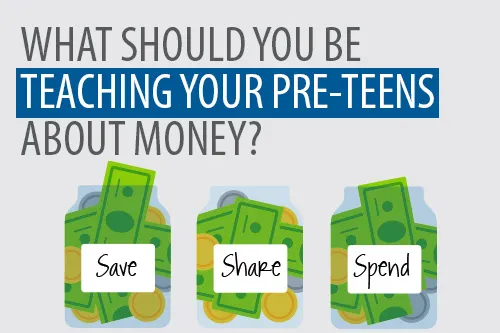
April is Youth Financial Literacy Month, and if you are a parent, aunt, uncle, or grandparent, you can play a crucial role in teaching younger kids some basic money concepts that will be useful to them as they grow older. Kids grow up quickly and often must make decisions at a younger age than you might think. Many adults will tell you that their money struggles can usually be traced back to not having a solid foundation of basic money skills to make bigger financial decisions.
For kids who are not yet teenagers, what concepts do they need to learn?
Even for kids as young as 7 or 8, you can start with basic money concepts such as being a smart shopper, understanding that a money supply isn’t endless, and distinguishing between needs and wants. These three concepts are powerful tools that will help them throughout their lives. Building on this, it is important to help them understand that there are three uses for their money: saving it, spending it, and sharing it. These three concepts and three uses form the foundation of all money decisions.
How can adults help kids understand these financial concepts?
Start by including them in your daily activities with money. Involve them in planning for grocery shopping or buying other household items. Explain how you manage your spending so that the money lasts until the next paycheck. Take them shopping with you and explain why you are not buying certain items even though you may want them. This requires modeling the behaviors you want to instill in them. Kids at a young age can grasp more in-depth concepts, and adults must be willing to talk about money even if it feels uncomfortable at first.
Are there any activities that can help reinforce or teach important money lessons?
One great activity that reinforces smart shopping habits is to have kids comparison shop online for you. This saves you time and money and gets them in the habit of looking for deals and discounts. Another learning opportunity is the "Keep the Change" game. For example, instead of paying for their ice cream, give them $10 and tell them they can keep whatever they have left over. Some kids will spend almost all of it, while others will choose the $5 cone because they want to use the change for something else. This allows your kids to start making financial choices and see the consequences of those choices. Aunts, uncles, and grandparents can also be involved in the "Keep the Change" game. It allows someone to spoil the kids while also reinforcing smart money habits. Even playtime can reinforce these habits from playing store to board games.
Should allowances be part of a parent's plan to teach money skills?
This is a topic that each household needs to decide on how they want to handle teaching money smarts. For those who want to use an allowance, there are a couple of important points to keep in mind. First, make the allowance appropriate for their age. Second, the allowance should come with expected financial responsibility that matches the amount you are giving. The purpose of an allowance should be to teach budgeting skills and reinforce the save, spend, and share uses of money. Starting allowances early allows for an easier transition to high school and college years when you want your kids to have a spending plan. It is also important to remember that the amount will likely increase as your kids move into their teenage years, and it is important to add greater financial responsibility as they grow.